


Our weight loss programs are available to patients with a BMI of over 27 with a co-morbid factor or 30 with no co-morbid factor.
Body Mass Index, or BMI, is a measure of weight relative to height. To calculate your BMI, divide your weight kilos by your height (metres) squared.
A slightly easier way to do this using a calculator: enter your weight in (kilos), divide it by your height (metres) and then divide it by your height (metres) again. If the answer is not 15-40 start again – a common mistake is to use centimetres instead of metres or do the sum the wrong way round.
The resultant score is used to classify your health risk, see the graph below. If you fall into the obese category, it places you at a high risk of developing health complications.
BMI – less than 25- you’re at an ideal weight and shouldn’t worry about your weight, keep to a healthy diet and exercise regularly to maintain your weight.
BMI 25-27 - you’re overweight and should try to lose weight by reducing your calorie intake (eat a bit less) and take a bit more exercise.
BMI over 28 – you should aim to reduce your weight by reducing your calorie intake (eat a bit less) and take a bit more exercise. We would advise you to consult one of our doctors who may suggest one of the prescription drugs to help you shed the extra weight. You will still need to make changes to your lifestyle; the medicines will help you do that.
A BMI of 30 or more indicates 'obesity'.
The higher your BMI, the higher your health risk.
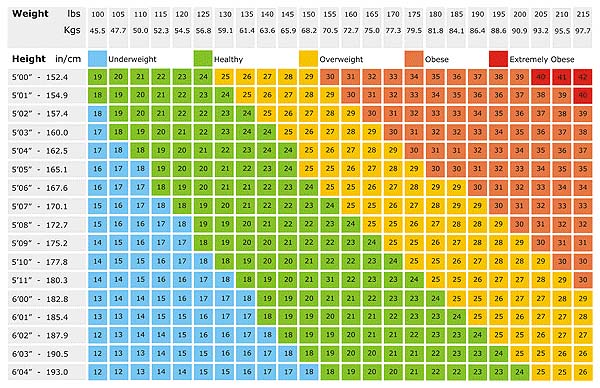

Research suggests that health risk increases exponentially beyond a BMI of 30. At this height to weight ratio a person is classified as 'clinically obese' and is considered to have a high risk of developing chronic diseases such as liver and heart problems, Diabetes, high blood pressure and Osteoarthritis.
The BMI is a useful tool for measuring health risk, however accurate classification of your health risk requires a holistic assessment by a healthcare professional.
Our doctors will measure your waist to hip ratio (fat around your abdomen carries a greater health risk than fat around your arms & legs), discuss your lifestyle and we may perform a Bio electrical Impedance Analysis to determine the amount of fat and muscle in your body.
If you are concerned about your BMI don't despair. We recommend making an appointment with one of our doctors to discuss your health status and risks.
A large waist measurement confers greater risk in a person who is overweight or obese, for a man over 38” is a problem and over 32” for a woman.
Waist–hip ratio or waist-to-hip ratio (WHR) is the ratio of the circumference of the waist to that of the hips. This is calculated as waist measurement divided by hip measurement ( W ÷ H ).

© Copyright 2026 | Privacy Policy